Roland Freisler
Nazi judge who presided over the People's Court.

Unknown · CC BY-SA 3.0 de
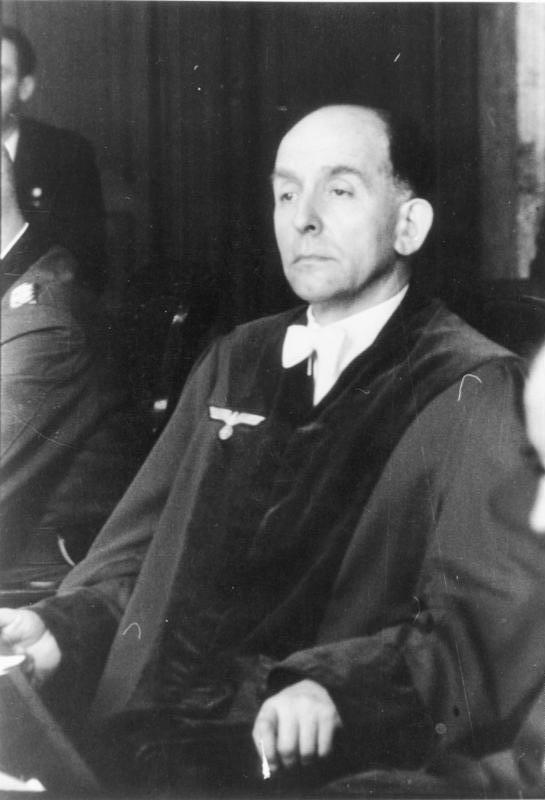
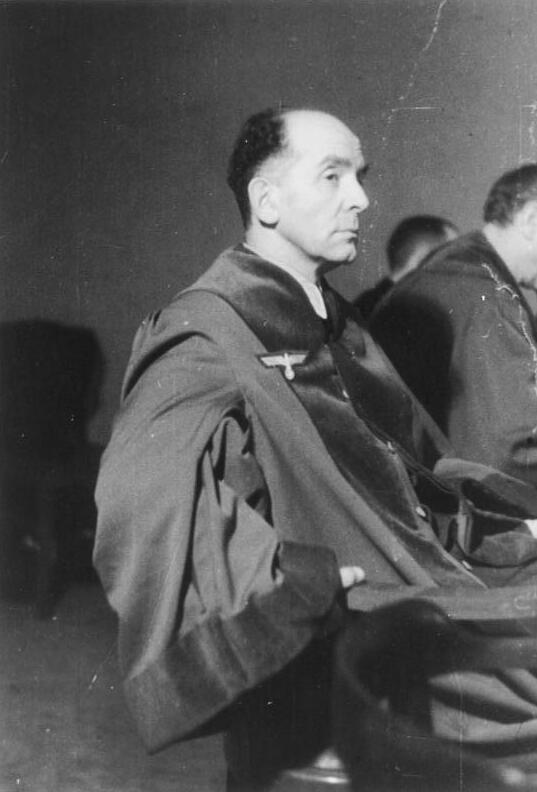
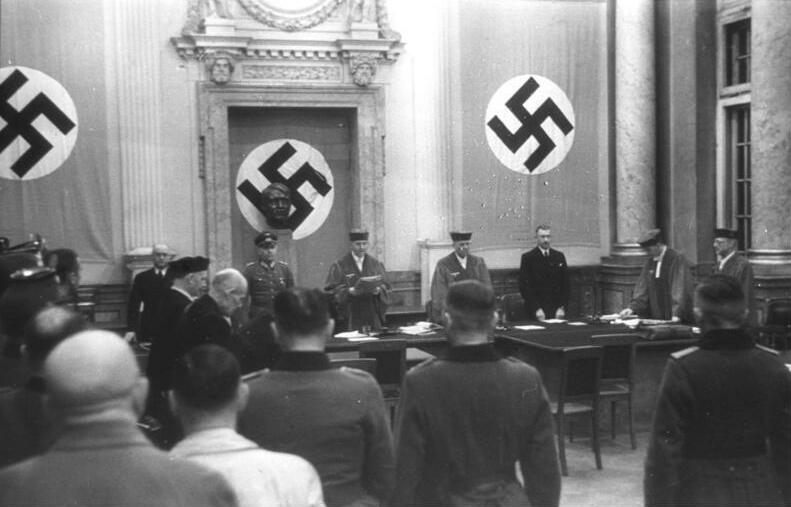
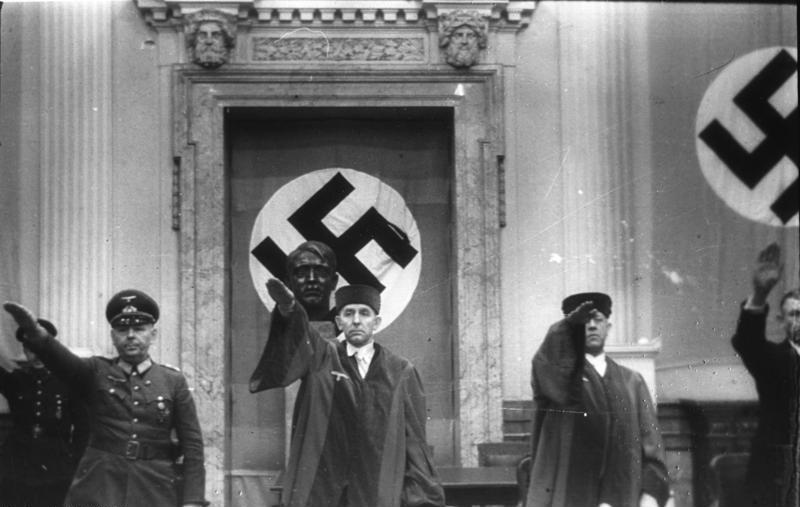
Roland Freisler was a German jurist and politician who served as president of the People's Court (Volksgerichtshof) from August 1942 until his death. He succeeded Otto Georg Thierack in that position.
- died
- 3 February 1945 during an American bombing raid on Berlin
- field
- Jurist, judge, politician
- nationality
- German
Verified Timeline
Lore & Background
Freisler succeeded Otto Georg Thierack as president of the People's Court in August 1942. Thierack had held the job, interrupted by two stints in the armed forces, from May 1936 until that time. After leaving the presidency, Thierack went on to become Reich Minister of Justice on 20 August 1942. Freisler's tenure as president of the People's Court lasted until his death on 3 February 1945 during an American bombing raid on Berlin.
Reader's Guide
Freisler's significance lies in his role as president of the People's Court from August 1942 to February 1945. His courtroom behavior was marked by histrionics and attempts to humiliate defendants. He was killed in an American bombing raid on Berlin on 3 February 1945.
Did You Know?
- Roland Freisler succeeded Otto Georg Thierack as president of the People's Court in August 1942.
- Thierack had held the presidency of the People's Court from May 1936 until August 1942, interrupted by two stints in the armed forces.
- Freisler attended the Wannsee Conference in 1942 as a representative of the Reich Ministry of Justice.
- Freisler was killed on 3 February 1945 during an American bombing raid on Berlin.
From Saxon Town to the Front Lines
Otto Georg Thierack entered the world on 19 April 1889 in the small Saxon town of Wurzen. Like many young men of his generation, he answered the call to arms when the First World War erupted, enlisting as a volunteer in 1914 and serving on the front until the armistice in 1918. By the war's end he had earned the rank of lieutenant, though the conflict left a visible mark on him: a facial injury that would accompany him for the rest of his life. His service was recognized with the Iron Cross, second class. Once the guns fell silent, Thierack returned to the interrupted path of legal education, completing his studies and passing the Assessor examination in 1920. That same year he secured a position as a court Assessor in Saxony, the first formal step in a legal career that would, within a decade, place him at the very apex of the Nazi judicial machine. His early years thus combined military discipline with the beginnings of a professional identity in the courts of his home state.
Climbing the Nazi Judicial Ladder
Thierack's alignment with the National Socialists was formalized on 1 August 1932, a full year before Hitler's government took power. When the Nazis seized control in 1933, his trajectory accelerated dramatically. He was appointed Saxony's justice minister on 12 May 1933, tasked with reshaping the region's courts along party lines. His ascent was not solely a product of party loyalty; he had also led the Rechtswahrerbund, the National Socialist organization for jurists, giving him a network and ideological credibility that pure party membership could not provide. Through a series of mid-level appointments he reached the vice presidency of the Reich Court in 1935. Then, in May 1936, he was installed as president of the Volksgerichtshof, the special People's Court that had been created only two years earlier in 1934. He occupied that seat, with two interruptions for military service, until August 1942, when Roland Freisler took over. On the same day he stepped down from the Volksgerichtshof, Thierack succeeded Hans Frank as head of the Academy for German Law.
Architect of Judicial Terror
When Thierack assumed the portfolio of Reich Minister of Justice on 20 August 1942, he moved swiftly to tighten the regime's grip on the courts. In October he launched the Richterbriefe, a monthly circular that circulated anonymized model rulings drawn from the leadership's own perspective, effectively dictating how lower courts should reason. He also instituted the Vorschauen and Nachschauen system, under which presidents of higher state courts were required, at least every two weeks in matters of public interest, to confer with the public prosecutor and the State Court president on how a case ought to be decided before any verdict was rendered. Clemency procedures for death-row prisoners were drastically streamlined. In September 1942 he ordered that prisoners identified as Jews, Roma, Russians, Poles serving over three years, Czechs, and Germans serving over eight years be reclassified as "asocial elements" and handed to Heinrich Himmler's SS for forced labor. That December, the execution shed at Plötzensee Prison was fitted with eight iron hooks to enable multiple simultaneous hangings. Mass executions commenced on 7 September 1943, and when some prisoners were hanged in error due to the speed of the process, Thierack waved off the mistakes and ordered the killings to continue.
The Unfinished Reckoning
However, on 5 May 1945, Reichspräsident Karl Dönitz, who had succeeded Hitler, dismissed him from office. With the war over, the Allied forces took Thierack into custody. He was destined to face the Nuremberg Judges' Trial, a proceeding specifically designed to prosecute senior German jurists for their roles in the Nazi legal system. Yet the tribunal never got the chance to hear his case. Before the trial could begin, Thierack ended his own life by poison at Sennelager, near Paderborn, on 26 October 1946. His death denied the international court an opportunity to examine, in open proceedings, the full scope of the judicial machinery he had helped construct and direct. The Richterbriefe, the pre-trial consultations, the streamlined death sentences, and the mass hangings at Plötzensee all passed into history without the architect ever having to stand before a judge and answer for them.
Gallery
Frequently Asked Questions
Who is Roland Freisler?
Roland Freisler was a German jurist, judge, and politician born in Celle, Lower Saxony, on 30 October 1893. He is best known for heading the Nazi-era People's Court and presiding over its most notorious show trials.
What positions did Roland Freisler hold?
From 1935 to 1942 he served as State Secretary of the Reich Ministry of Justice, and from 1942 until his death he acted as president of the People's Court in Berlin.
How did Roland Freisler die?
Freisler was killed on 3 February 1945 when an American bombing raid struck the Berlin courthouse where he was working.
Why is Roland Freisler notable in legal history?
He is remembered for his theatrical, confrontational courtroom manner, his deliberate efforts to humiliate the accused, and for signing more than 5,000 death sentences during his tenure.
Which famous trials did Roland Freisler preside over?
He oversaw the proceedings against the White Rose student resistance group and the conspirators of the 20 July 1944 plot to assassinate Hitler, both of which ended in executions.
More in Jurists And Legal Scholars 25-31
Elsewhere in the Jurists And Legal Scholars universe
Spotted an error? Know more?
This is a living reference — every entry is fact-audited, and reader corrections feed straight into our audit queue. Suggest an edit · See this site's audit record